
Published 27 April 2026 · Last updated 11 June 2026
NRS Healthcare Handy Bar Car Transfer Aid
Non-Slip Support Handle, Fits Most Vehicles, Built-In Seatbelt Cutter
£34.99
Buy Now on AmazonWhy Car Mobility Aids Matter
For many people with reduced mobility, getting in and out of a car is one of the most challenging parts of daily life. The twisting, bending, and weight-bearing involved can cause pain, increase fall risk, and make journeys stressful. Car mobility aids are designed to make these transfers safer, more comfortable, and more independent.
The right car aid can make a significant difference to your quality of life and independence.
Swivel Seat Cushions
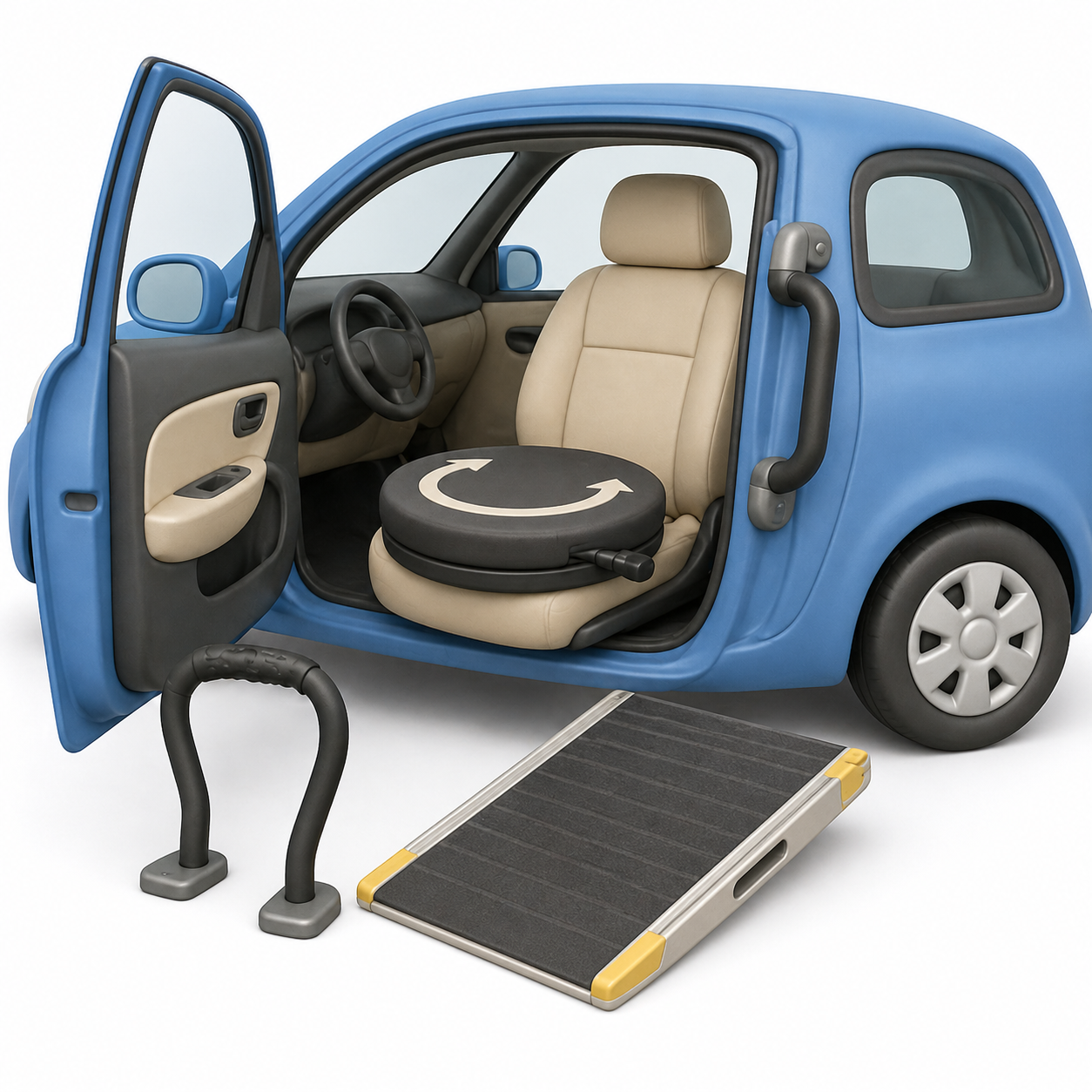
A swivel seat cushion is one of the simplest and most affordable car mobility aids. It sits on top of the car seat and rotates freely, allowing you to turn your body without twisting your hips, knees, or spine.
How They Work
You sit on the cushion with your legs outside the car, then use your hands to guide yourself around until you are facing forward. The cushion does the rotating for you, eliminating the need to shuffle or twist on the seat.
Key Features to Look For
- Non-slip base that grips the car seat
- Weight capacity suitable for the user (most support up to 20 stone)
- Comfortable padding for longer journeys
- Compact enough to transfer between vehicles
Prices typically range from around £10 for a basic foam cushion to £40 or more for a padded, ergonomic version.
Handybars and Grab Handles
A handybar is a portable support handle that slots into the U-shaped striker plate on your car door frame, giving you a sturdy grip to hold onto when standing up from or lowering yourself into the car.
Benefits
- Provides a secure, weight-bearing handhold (typically supports up to 21 stone)
- Compact and portable, fits in a glovebox or door pocket
- Works with most car makes and models
- No installation required
Handybars are often sold as a combo pack with a swivel cushion, which together provide a complete transfer solution for around £30 to £60.
Car Transfer Boards and Sliding Sheets
For people who cannot stand or bear weight on their legs, a transfer board provides a bridge between the wheelchair and the car seat. The user slides across the board rather than standing and pivoting.
Sliding sheets can also be placed on the car seat to reduce friction. This makes it easier to shuffle into position once seated.
Seatbelt Aids
Reaching and fastening a seatbelt can be difficult if you have limited shoulder mobility or grip strength. Seatbelt aids include:
- Seatbelt reachers that extend the belt towards you so you do not have to twist
- Seatbelt release handles that make the button easier to press
- Seatbelt guides that hold the belt away from your neck or face
Portable Car Ramps
If you use a mobility scooter or powered wheelchair, a portable ramp allows you to load it into a vehicle without needing a permanent vehicle adaptation. Folding ramps are available in various lengths and weight capacities.
Things to Consider
- The ramp must be long enough to create a safe gradient (a steeper ramp is harder to use)
- Check the weight capacity covers your scooter or wheelchair plus the user if riding up
- Folding or telescopic ramps are easier to store
- Non-slip surfaces are essential for safety
Vehicle Hoists and Lifts
For heavier mobility equipment, a vehicle hoist can lift and store a scooter or wheelchair in the boot automatically. These are more expensive (typically £1,500 to £4,000 fitted) but eliminate the physical effort of loading equipment manually.
Hoists are available through the Motability Scheme as an adaptation, or can be fitted privately by specialist installers.
Key Ring and Key Turner Aids
If you have limited grip strength or dexterity, turning a car key can be painful or impossible. Key turner aids provide a larger, ergonomic handle that gives you more use. For cars with push-button start, this is less of an issue, but many older vehicles still require a physical key.
How to Choose the Right Car Mobility Aid
The best car mobility aid depends on your specific needs. Consider the following:
- Your main difficulty – is it standing up, turning, reaching the seatbelt, or loading equipment?
- Your vehicle – seat height, door width, and boot space all affect which aids work best
- Portability – do you need aids that move between different cars?
- Budget – simple aids like swivel cushions start from £10, while hoists can cost thousands
- Try before you buy – many mobility shops allow you to test aids with your own vehicle
Where to Get Help
Your local occupational therapist can assess your needs and recommend suitable car mobility aids. Many aids are available through the NHS or your local council’s equipment service. You can also find a wide range of car mobility products from specialist retailers like CareCo, Ability Superstore, and Essential Aids.
Sources & Useful Resources
Official Resources
- GOV.UK: Apply for a Blue Badge – disabled parking gives access to wider bays
- GOV.UK: Financial Help (Transport)
Charity & Advisory Resources
- Disabled Living Foundation – independent advice on daily living equipment
- RiDC: Getting In and Out of a Car
Product Comparisons
- CareCo: Car Mobility Accessories – swivel cushions, grab handles, and transfer aids
Helpful Videos
Published 27 April 2026 · Last updated 11 June 2026
Cite this page
Free to reuse with credit to Review Mobility (CC BY 4.0). A link back is appreciated.