
Published 6 July 2026 · Last updated 16 August 2026
We only recommend products we think are worth it. If you buy through a link on this page we may earn a small commission from Amazon, at no extra cost to you. This is not medical advice. If you are unsure what you need, ask your GP or occupational therapist.
A raised toilet seat sits on top of your existing seat and lifts the height by a few inches. That smaller drop makes a real difference if bending your knees or hips is painful, if you have had a hip or knee replacement, or if your leg strength is not what it was. The right one comes down to two things: how much extra height you need, and whether you need handles to push up on.
Here are seven we rate, from a cheap low-rise seat to an adjustable model with arm supports.
How to choose a raised toilet seat
Height (the rise). These usually add 2, 4 or 6 inches. A 2-inch seat is a gentle lift for stiff knees. Four inches suits most people recovering from surgery. Six inches is a big jump and mainly for tall users or a strict hip precaution, so measure before you buy or it can feel too high.
How it fixes on. Cheaper seats rest on the pan and are held by brackets underneath. Locking models clamp to the bowl so they cannot shift when you lean, which feels far more secure. If you or a carer will take it on and off often, a clamp system is worth the extra money.
Handles or no handles. Seats with arm rests give you something to push down on as you stand. They take up more room and cost more, but for weaker arms or poor balance they are the safer choice.
Weight limit and fit. Check the user weight limit, and check your toilet shape. Most fit standard and D-shaped pans, but a few do not, so read the fitting notes.
A quick money tip. If you have a long-term condition or disability you can often buy mobility aids free of VAT. Amazon does not usually apply VAT relief at checkout, so for a larger buy it can be worth comparing a specialist retailer too.
The best raised toilet seats




As an Amazon Associate I earn from qualifying purchases. (paid link)
Best all-rounder: Eazy 4 Inch Raised Toilet Seat with Lid
This is the one most people should look at first. It clamps to the bowl so it locks in place, adds a sensible 4 inches, and comes with a lid so the bathroom still looks normal. Reviewers rate it for feeling solid rather than wobbly.
The catch: the lid adds a little bulk, and at 4 inches it will not be enough if you have been told to avoid low seats completely. Around £30.
Best budget buy: Aidapt 4 Inch Raised Toilet Seat
Aidapt is a long-standing UK mobility brand and this is about the cheapest way to add height. It rests on the pan and clips under the rim, so it does the job without any fuss.
The catch: it rests on the bowl rather than locking to it, so it can move slightly if you lean hard to one side, and the reviews are a bit more mixed than the pricier seats. Around £16.
Best low rise: Homecraft 2 Inch Raised Toilet Seat
If you only need a small lift, a 6-inch seat is overkill and can make things harder. This Homecraft seat adds a gentle 2 inches, which is often all you need for stiff or sore knees.
The catch: two inches will not be enough after a hip replacement, where you usually need more clearance. Around £23.
Best for maximum height: Eazy 6 Inch Raised Toilet Seat with Lid
Same locking design as our all-rounder but with a full 6 inches of extra height, plus a lid. This is the one to pick if you are tall, or if a hospital has told you to keep your hips high after surgery.
The catch: 6 inches is a lot. For an average-height user it can leave your feet dangling, which is less stable, so only go this high if you actually need to. Around £35.
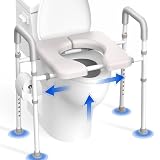
Best with handles: Agrish Raised Toilet Seat with Arm Supports
This one adds height and gives you padded arm rests to push up on, with adjustable height and width and a generous 182 kg weight limit. For weaker arms, poor balance, or heavier users, that support is the whole point.
The catch: it is bulkier and sits around the toilet like a small frame, so it suits a bathroom with a bit of space rather than a tiny cloakroom. Around £64.
Best adjustable: KEKOY Raised Toilet Seat (7 heights, 3 widths)
If you are not sure exactly what height suits you, this takes the guesswork out. You can set it to seven heights and three widths, so you can dial it in and change it later if your needs change.
The catch: it is the priciest here, and more moving parts mean a little more to wipe down when you clean it. Around £90.
Best premium finish: KMINA Raised Toilet Seat with Soft-Close Lid
A tidier, more discreet option that adds 3 inches and has a soft-close lid, so it looks and feels closer to a normal seat than most raised seats do.
The catch: you pay a premium for the finish, and the 3-inch rise is fixed, so measure first to be sure it is enough. Around £70.
Prices are a guide and change often, so check the live price on Amazon before you buy.
Frequently asked questions
What height raised toilet seat do I need?
Most people do well with a 4-inch seat. Choose 2 inches if you only need a small lift for sore knees, and 6 inches if you are tall or have been given a strict hip precaution after surgery. If you can, ask an occupational therapist to check, since a seat that is too high is less safe, not more.
Will a raised toilet seat slip or move?
Seats that clamp or lock to the bowl are very stable. Cheaper seats that simply rest on the pan can shift a little if you lean hard to one side, which is why the locking models are worth it if you feel unsteady.
Can I get a raised toilet seat free on the NHS?
Sometimes. An occupational therapist assessment through your GP or council can provide basic equipment at no cost, though the range is limited and there can be a wait. Many people buy their own to get the exact height or the handles they want.
Do they fit every toilet?
Most fit standard and D-shaped pans. A few shapes are trickier, so check the fitting notes for your toilet before buying, and keep the packaging until you have tried it.
Once the height is sorted, a lot of people pair a raised seat with a nearby grab rail or a bathroom safety aid for extra support. You will find more in our bathroom mobility guides.
Published 6 July 2026 · Last updated 16 August 2026
Cite this page
Free to reuse with credit to Review Mobility (CC BY 4.0). A link back is appreciated.