
Published 5 October 2024 · Last updated 22 October 2026
Links to Amazon on this page are paid links: we earn a commission if you buy, at no extra cost to you. No company paid to appear here. How we make money.
In stock on Amazon UK when we checked on 13 October 2026. Prices shown are live from Amazon.
| Photo | Title | Price | Buy |
|---|---|---|---|

| PEPE Mobility Raised Toilet Seat with Handles and Lid, 10 cm (3.9"), White | Riser for Elderly and Disabled Adults, Hip Replacement Recovery, Two Side Clamps, Fits Oval and Round Pans, Polypropylene | £44.99 |

|

| HOMLAND Raised Toilet Seats for Elderly, Toilet Seat Riser with Handles | 181kg Capacity, Adjustable Height & Width, Padded Seat & Non-Slip Feet, Aluminum Raised Toilet Seat, Fits Most Toilets | £89.99 |
|
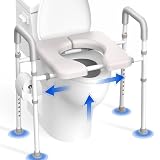
| Agrish Raised Toilet Seat with Handles, Toilet Seat Riser for Elderly | 7-Level Height and 4-Level Width Adjustable, Toilet Riser Seat for Disable, Soft Cushion, Non-Slip, Fit Any Toilets | £69.99 |
|
As an Amazon Associate I earn from qualifying purchases. (paid link)
Using the toilet represents one of the most physically demanding activities in daily life, requiring strength, flexibility, balance, and the ability to perform a controlled squat movement repeatedly throughout the day. For elderly people, those recovering from surgery, individuals with arthritis or other mobility conditions, and anyone experiencing weakness or pain, this routine activity becomes genuinely difficult or impossible without support. The consequence is often loss of independence in a most intimate and essential aspect of personal care. This creates emotional distress alongside practical challenges. Fortunately, a full range of toilet aids exists to address these difficulties, from simple raised seats costing under £50 to sophisticated frames and commodes providing multiple support options. This guide explores the full spectrum of toilet aids available in the UK, helping you understand which solutions will genuinely improve your situation and restore bathroom independence.
The psychological importance of maintaining toilet independence cannot be overestimated. Being unable to manage this most basic personal function independently represents a profound loss of autonomy and dignity that affects mental health, self-esteem, and overall quality of life. Modern toilet aids are specifically engineered to preserve this independence, allowing people to continue using standard toilets with appropriate support, rather than forcing them into alternative arrangements that feel humiliating or restrictive. Understanding the options available and selecting aids suited to your specific needs enables you to maintain control over this essential aspect of personal care.
Why the Right Toilet Aid Makes Such a Difference
Toilet difficulties affect a surprisingly large percentage of the population, particularly older adults and disabled people. The physical demands of toilet use, specifically the squat movement required to sit down and stand up, require strength primarily in the quadriceps and hip extensors, flexibility in the hips and knees, balance during the movement, and the ability to adjust position on a small seat. For people with arthritis in these joints, weakness from deconditioning or illness, balance problems from neurological conditions, or post-operative limitations, this movement becomes painfully difficult or impossible. Some people develop toileting accidents simply because they cannot access the toilet quickly enough due to movement difficulties, adding incontinence concerns to mobility challenges.
The consequences of toilet difficulties extend far beyond mere inconvenience. When people cannot manage toileting independently, they often restrict fluid intake to reduce toilet frequency, leading to dehydration and complications including urinary tract infections, constipation, and confusion. Social isolation increases as people avoid leaving home due to toileting concerns. Dependence on carers for intimate personal care creates emotional distress and damages self-image. Accidents damage dignity and confidence. The right toilet aid eliminates these consequences by restoring the ability to manage toileting independently, preserving not only practical function but also psychological wellbeing and quality of life.
The financial consequences should not be ignored either. Hospital admissions from falls related to toileting, urinary tract infections resulting from dehydration to limit toileting, and the cost of incontinence products are all substantially reduced when toilet aids enable independent access. For the individual, the investment in appropriate toilet aids typically costs £50 to £500, whilst the cost of addressing complications from toileting difficulties often exceeds thousands of pounds in health service costs. From every perspective, choosing appropriate toilet aids represents genuinely wise investment in health and quality of life.
Raised Toilet Seats
Raised toilet seats are the most common toilet aid, addressing the fundamental problem that standard toilet seats sit only 40-43 centimetres from the floor, requiring a deep squat movement to sit and an equivalent effort to stand. By adding 10-15 centimetres to the height, raising the total to approximately 50-55 centimetres, the physical demands of the movement decrease dramatically. The difference is meaningful; the quadriceps and hip extensors must work less intensely, the movement range required is reduced, and the stress on joints decreases substantially. For many people with arthritis or weakness, this modest height increase transforms toileting from painfully difficult to comfortably achievable.
Fixed Raised Toilet Seats
Fixed raised toilet seats permanently replace the existing toilet seat, attached using bolts to the toilet bowl. They are the most stable type of raised seat. Installation requires removing the existing seat by unbolting it, positioning the raised seat, and bolting it in place, a straightforward process requiring only basic tools, though people with limited hand strength may need assistance. Once installed, fixed raised seats require no maintenance beyond occasional cleaning. They are suitable for people using one specific toilet regularly and who do not need to remove the seat. The main disadvantage is that removal requires unbolting, which is impractical if multiple people use the same toilet and some prefer the standard height. Fixed raised seats typically cost £30 to £80.
The stability of fixed seats makes them ideal for people with balance problems or limited strength, as the seat does not move when you sit or stand. The reduced height difference compared to removable seats also means slightly less strength is required for transfer, which matters for people with severe weakness. Fixed seats are available in various materials; plastic seats are lightweight and easy to clean, whilst padded seats are more comfortable for extended use but require more careful drying to prevent mould. Some fixed seats include integrated armrests, which substantially reduce the strength required to stand from the toilet by allowing you to push with your arms whilst lifting with your legs.
Raised Toilet Seats with Arms
Raised seats with integrated armrests provide both height increase and side support during transfers. The armrests substantially reduce the physical demands of standing from the toilet by allowing you to use your arms to help lift your body weight, rather than relying entirely on leg strength. This feature is particularly valuable for people with significant weakness, arthritis in multiple joints, or those recovering from lower limb surgery where leg strength must be guarded. Armrests also provide balance support for people with balance problems. This allows them to stabilise themselves during the transfer. Some models have armrests that can be folded or removed. This allows flexibility for households where different people use the toilet.
The trade-off of raised seats with armrests is reduced space on the toilet seat due to the armrests occupying lateral space. For people with larger frames or those who move about on the seat, this reduced space can be uncomfortable. The armrests can also make the seat incompatible with certain toilet shapes or narrower toilets. Installation is straightforward if the seat is bolted; removable models with armrests work like standard removable seats. The added support of armrests makes a genuine difference for people who need it, often converting toileting from dependent to independent. Raised seats with armrests typically cost £60 to £150.
Padded and Soft Raised Seats
Padded raised toilet seats provide comfort for people who spend extended time on the toilet, or for those with pressure-sensitive areas from incontinence, skin conditions, or pain from sitting on hard surfaces. The padding reduces pressure and improves comfort, which matters particularly for people with haemorrhoids, lower back pain, or those taking medications that affect skin sensitivity. Padded seats require more careful maintenance to prevent mould and mildew growth in the padding, which can harbour bacteria in humid bathroom environments. Regular cleaning and thorough drying after use help maintain hygiene. Some padded seats have removable covers that can be washed.
The height increase provided by padded seats is often slightly less than non-padded seats because the padding compresses, though quality padded seats maintain adequate height increase despite compression. For many people, the comfort benefit of padding outweighs the slight reduction in height increase. Padded raised seats cost typically £40 to £120, depending on quality and materials. They are available both as fixed and removable models, with and without armrests. This allows considerable customisation to match your specific needs and preferences.
Toilet Frames and Surrounds
Toilet frames are freestanding structures that surround the toilet. Unlike raised seats that increase height, frames work by providing external support during transfers, allowing you to lower yourself using the frame rails for balance and upper body strength, and using the rails to help lift yourself when standing. Frames are particularly valuable for people whose primary limitation is lack of upper body strength to raise themselves, as they convert what would be an impossible transfer into an achievable one with frame support. Best toilet frames provides full guidance on frame selection and features.
Frames are supplied as complete structures that do not attach to the toilet, eliminating installation concerns. They simply sit around the toilet, with legs adjustable for stability on different floor surfaces. For people living in rental properties or those unwilling to modify their toilet permanently, frames offer the full safety and support benefits of grab rails without any permanent modification. Frames are easy to remove for cleaning both the frame and the toilet. The primary disadvantage is that frames occupy more bathroom space than other toilet aids, which can be problematic in small bathrooms. Some frames are foldable or have removable components to reduce storage space when not in use.
Height adjustment on many frames allows exact positioning at your comfortable height, important for individualised comfort. Armrest height and positioning affects comfort during transfer; frames with adjustable or cushioned armrests are more comfortable than basic models. Weight capacity is important; quality toilet frames support 150-200+ kilograms. Material quality matters; stainless steel frames resist rust better than painted steel, which can corrode in humid bathroom environments. Toilet frames typically cost £80 to £250, depending on quality and features. For many people, the support provided by a frame makes the difference between dependent and independent toileting.
Free-Standing Commodes
Free-standing commodes are portable toilet alternatives, typically chair-like structures with a seat opening and removable waste container underneath. They serve multiple purposes: they provide toileting access for people unable to walk to the toilet, they allow toileting in bedrooms or other locations away from the actual toilet, and they can serve as portable solutions for travel or temporary situations. Commodes are particularly valuable for people with severe mobility limitations, those recovering from major surgery when walking is not yet safe, and those in the end stages of conditions where walking is impossible. Best commode liners offers guidance on essential accessories for maintaining commodes hygienically.
The primary advantage of commodes is mobility; they can be positioned anywhere convenient, removing the need to navigate to a conventional toilet. They are particularly valuable at night when toilet access is urgent but navigating to the bathroom is difficult or risky. For bedridden people, commodes provide basic toileting access without moving to a standard toilet. Commodes come in various styles: simple basic models with no special features, deluxe models with padded seats and armrests providing comfort, and bariatric models with reinforced construction and higher weight capacity for larger users. Some commodes have splash guards to reduce spillage of liquid waste. Others have drop-bucket systems that are cleaner to empty than older fixed-tank models.
The disadvantage of commodes is that they require emptying and cleaning, which many people find unpleasant. They occupy additional space in the home. Hygiene requires careful cleaning to prevent odour and bacterial growth. The waste container must be emptied regularly, which is impractical for people unable to perform this task themselves or living alone. Despite these disadvantages, for people with severe limitations, commodes provide independence and dignity that would otherwise be impossible. Basic commodes cost £50 to £150, whilst deluxe models cost £150 to £300 or more.
Toilet Aids for Post-Surgery Recovery
After Hip Replacement
Hip replacement surgery creates specific temporary restrictions on movement called hip precautions, which typically include avoiding hip flexion beyond approximately 90 degrees (bending the hip more than a right angle), avoiding hip adduction (crossing the legs), and avoiding hip internal rotation (turning the hip inward). These restrictions mean that standard toileting movements that require greater hip flexion become impossible during the recovery period, which typically lasts 8-12 weeks post-operatively. Raised toilet seats alone are insufficient because even a significantly raised seat may still require more hip flexion than precautions allow. The solution is combining a raised toilet seat, typically one at maximum height approximately 50-55 centimetres, with a toilet frame providing external support, allowing you to lower yourself slowly using frame rails for control, maintaining the hip angle within safe limits throughout.
Toilet aids specifically designed for hip precautions include extra-high raised seats (20+ centimetres height increase) that virtually eliminate hip flexion requirements. Some specialised models include a reacher or grabber tool to help with wiping after toileting, addressing the difficulty of bending to perform personal hygiene whilst maintaining hip precautions. An occupational therapist assessment before or immediately after hip surgery identifies the specific toilet aid configuration your individual movement pattern requires. The good news is that these aids are typically temporary solutions loaned from NHS equipment services, returning them once recovery is complete and precautions are lifted.
For Knee Replacement
Knee replacement surgery involves different restrictions than hip surgery; typically the knee must be kept relatively straight whilst healing, meaning movements that require full knee bending become difficult or impossible. Post-operative knee precautions usually last 6-8 weeks, after which gradual return to full movement begins. The primary toilet aid needed for knee replacement is a raised seat that increases height significantly, reducing the depth of knee bending required during sitting and standing. A frame providing external support allows you to control the lowering and raising movement, protecting the healing knee from sudden stress.
Most people recover quickly enough that temporary aids suffice; as the knee strengthens and pain resolves, movement gradually becomes easier and aids become unnecessary. An occupational therapist provides the most appropriate aids for your specific restriction level and timeline. Some people also benefit from ice packs after toileting to reduce swelling, and careful positioning on the toilet to support the healing knee on a stool if complete extension is required.
Toilet Aids for Specific Conditions
After Hip or Knee Replacement
The period immediately following joint replacement surgery represents a time of significant vulnerability when temporary toilet aids enable safe return to independent toileting despite post-operative restrictions. Combining raised seats with frames or armrests provides the height reduction and external support needed to maintain precautions whilst toileting. As healing progresses and flexibility improves, aids can be progressively removed, returning to independence as surgical restrictions ease. This temporary nature makes NHS equipment loan services invaluable; temporary access to aids without purchase cost enables safe recovery without permanent adaptation to the home.
For Arthritis and Limited Mobility
People with arthritis benefit from toilet aids addressing the specific challenges of their condition: height reduction decreasing squat depth, armrests providing lifting assistance, padded seats reducing pressure and discomfort, and frames offering external support. Raised seats with integrated armrests often provide optimal combination of features for arthritic users. The therapeutic benefit of warm water immersion is sometimes combined with toilet aids, though this requires careful sequencing of activities. Best bathroom chairs for bathing can sometimes also serve toileting functions if carefully selected. Some people benefit from heat therapy applied before toileting, warming joints and improving flexibility, though allowing adequate cooling before using toilet aids. Arthritis tips offers broader strategies for managing arthritis throughout the home.
For Bariatric Users
Bariatric toilet aids address the specific needs of people with obesity or very large frames, featuring reinforced construction and higher weight capacity than standard aids. Bariatric raised seats typically support 200-300+ kilograms and are constructed from heavy-duty materials. Bariatric toilet frames are similarly reinforced. Bariatric commodes are available for people with severe mobility limitations. The primary consideration for bariatric users is that standard aids may not provide adequate safety margin. This makes it essential to verify weight capacity and choose aids specifically designed for bariatric use. Professional assessment by occupational therapists ensures safe aid selection appropriate to individual circumstances.
How to Choose the Right Toilet Aid
Selecting the most helpful toilet aid requires honest assessment of your specific limitations and what would most improve your toileting independence. Do you struggle primarily with the strength to stand up, the stability for balance, the flexibility to lower yourself deeply, or the fear of falling? Your answer directs you to different aids: strength limitations suggest frames or armrests, balance problems suggest frames or wall-mounted grab rails, flexibility limitations suggest maximum-height raised seats, fear suggests any of these options depending on what specifically frightens you most. Best bathroom mobility aids provides full context on how toilet aids fit within broader bathroom accessibility strategies.
Consider whether temporary aids suffice or whether you need permanent solutions. Post-operative restrictions require temporary high-level aids that can be returned once healing is complete. Chronic conditions require permanent aids selecting based on long-term comfort and safety. Your own tolerance for adaptation matters; some people readily accept permanent installations, whilst others strongly prefer removable aids. Rental status affects your options; fixed installations are impossible in rental properties, requiring frame or removable-seat solutions. Household composition matters if multiple people use the toilet; you must balance your needs with the preferences of others sharing the toilet.
Height, weight, and body shape affect which aids work best. Some people find frames too bulky, others find them essential. Some people fit comfortably on raised seats whilst others find them uncomfortable. The only way to know for certain is to test aids before purchasing; many NHS occupational therapy services provide loan equipment allowing trial before purchase. Alternatively, reputable suppliers sometimes allow brief trials or have lenient return policies. Discussing specific needs with occupational therapists or experienced equipment suppliers helps identify which aids deserve priority in your selection process. Occupational therapy benefits explains how professional assessment improves aid selection outcomes.
Getting Toilet Aids Through the NHS (OT Assessment, Loan Equipment, Purchasing)
Many toilet aids are available through NHS equipment loan services at no cost to eligible users. The first step is requesting an assessment from an occupational therapist. You can request referral through your GP, contact your local council’s social services department, or request assessment directly from your NHS trust’s occupational therapy service. An occupational therapist will visit your home, observe your toileting difficulties, discuss your specific limitations and needs, and recommend appropriate aids. Their professional expertise ensures that recommendations address your actual requirements rather than generic assumptions.
If you qualify for support, the occupational therapist will refer you to the local equipment loan service, which will provide recommended aids at no cost. Equipment is loaned to you, remaining NHS property, and is collected when you no longer require it. This is particularly valuable for temporary needs such as post-surgical recovery. Some local authorities maintain loan pools of commonly needed items including raised seats, frames, and commodes. This allows immediate access for eligible users. Waiting times vary; some areas provide equipment within days, whilst others require several weeks. If you need urgent solutions, private purchase is an option whilst awaiting NHS provision.
For permanent conditions where NHS loan does not apply, the Disabled Facilities Grant (DFG) sometimes provides funding for major toilet adaptations including grab rail installation. The DFG is means-tested based on household income and available savings. Some people qualify for fully-funded adaptations, whilst others qualify for partial funding requiring personal contribution. The DFG process requires occupational therapy assessment, application through local council, and typically takes several months. Stairlift grants offers additional information on how accessibility funding mechanisms work across various home adaptations.
Purchasing toilet aids privately costs relatively little for basic items; raised seats cost £30 to £150, frames cost £80 to £250, and commodes cost £50 to £300 or more depending on quality and features. Many reputable suppliers offer quality aids at reasonable prices. Some charities provide grants or reduced-cost equipment for people meeting eligibility criteria. Age UK, condition-specific charities, and local charities sometimes support toilet aid provision. Researching available support in your local area can uncover resources many people overlook.
Frequently Asked Questions
What is the difference between a raised toilet seat and a toilet frame?
A raised toilet seat increases the height of the existing toilet, reducing the depth of the squat movement required. A toilet frame is a freestanding structure providing grab rails on both sides for support during transfers. Many people benefit from combining both, using the raised seat for height reduction and frame rails for external support during movement.
How do I know what height raised toilet seat I need?
Ideally, a raised toilet seat should position you so that your thighs are approximately parallel to the floor when sitting, with knees at roughly 90 degrees. Your feet should rest flat on the floor. The height depends on your individual measurements and comfort preferences. If you are short, you may prefer minimal height increase, whilst taller people typically benefit from maximum height. Testing different heights if possible helps identify what suits you best.
Are toilet frames safe for people with limited strength?
Yes, toilet frames are specifically designed to support people with limited strength by providing external rails to assist with transfers. The frame allows you to use your arm strength to help lift your body weight, rather than relying entirely on leg strength. Modern frames are engineered to support substantial weight, typically 150-200 kilograms or more. Professional assessment ensures the frame you select is appropriately designed for your weight and needs.
Can I use a commode at night to avoid walking to the toilet?
Yes, many people use commodes at night to avoid walking to the toilet when balance is impaired by sleep or when mobility is limited. Commodes at the bedside eliminate the hazard of navigating to a distant toilet in darkness, which is a common cause of nighttime falls in older people. Ensuring adequate cleaning and odour control is important for comfortable nighttime use. Some people combine commodes at night with full-toilet use during the day.
Will I be able to hide a toilet frame if I am embarrassed by it?
Toilet frames cannot realistically be hidden in most bathroom layouts. However, many modern frames are designed to be relatively unobtrusive, with simplified designs and finishes that blend better than older institutional-style frames. The important perspective is that functional aids used by millions of people are nothing to be embarrassed about; they represent practical solutions enabling independence. Speaking with occupational therapists or counsellors about feelings of embarrassment can help address these emotions. Many people find that the confidence that comes from safe, independent toileting quickly outweighs initial embarrassment about visible aids.
Published 5 October 2024 · Last updated 22 October 2026