
Published 23 June 2026 · Last updated 13 October 2026
Quick answer: You do not need a driving licence for a Class 2 (4mph) or Class 3 (8mph) mobility scooter, and neither needs tax, an MOT or insurance, though insurance is recommended. A Class 3 scooter must be registered with DVLA at no charge, and its rider must be at least 14. You may only drive one if you have trouble walking because of an injury, disability or medical condition, and you should be able to read a number plate from 12.3 metres. A scooter that is faster, wider or heavier than the classes allow needs a driving licence.
Last checked: 28 September 2026, against GOV.UK’s mobility scooter rules, the Highway Code (rules 36 to 46), DVLA leaflet INF304 and form V55/MV, and the Use of Invalid Carriages on Highways Regulations 1988 on legislation.gov.uk. This page is general information, not legal advice.
The two classes, and what falls outside them
| Class 2 | Class 3 | Not in a class | |
|---|---|---|---|
| Top speed | 4mph | 8mph (4mph on pavements) | Over 8mph |
| Where | Pavements, pedestrian areas, cycle tracks | Pavements and roads | Roads only |
| Max width | Not specified | 0.85m | Over 0.85m |
| Max unladen weight | 113.4kg | 150kg (200kg with necessary user equipment) | Over the class limit |
| DVLA registration | No | Yes, free | Yes |
| Driving licence | No | No | Yes |
| Minimum age | None set | 14 | Not specified |
The weights come from DVLA’s leaflet INF304 and regulation 7 of the 1988 Regulations, which since 2015 allows up to 200kg where the extra weight is equipment the user needs. The width limit is regulation 11, and the age limit regulation 4, which says a Class 3 carriage must not be used by a person aged under 14. GOV.UK says a vehicle that can go over 8mph, is wider than 0.85 metres or heavier than the limits is not in a class: it must be registered, can only be used on the road, and needs a valid driving licence.
For help choosing between the two, see our mobility scooter guide, which compares Class 2 and Class 3 models.
Who is allowed to drive one
GOV.UK limits use to someone who has trouble walking because of an injury, physical disability or medical condition, plus a few practical exceptions: taking the scooter for repair, a manufacturer testing it, demonstrating it for sale, and training a disabled user. It warns that if you use one without falling into those groups and have an accident, you face the same penalty as if you were driving a car, and you can go to prison, get a driving ban or an unlimited fine.
Eyesight
GOV.UK says the rider of a Class 2 or 3 scooter should be able to read a car registration number from 12.3 metres (40 feet). For a vehicle not in a class, the rider must be able to do so from 20 metres. It adds that you can be prosecuted if you have an accident because of poor eyesight. There is no eye test to take in advance, so it is worth checking this yourself, with glasses if you wear them.
On the pavement
Both classes may use pavements, footpaths and bridleways at up to 4mph, and must give way to pedestrians. The Highway Code (rule 39) says scooters must not travel faster than 4mph on pavements. Normal parking restrictions apply to scooters, and you should not leave one where it blocks the pavement for pedestrians, wheelchair users or pushchairs. Blue Badge concessions apply to scooters displaying a valid badge.
On the road
Only Class 3 scooters, and vehicles not in a class, may be driven on the road, in the direction of the traffic. GOV.UK lists what a road-going scooter must have: an efficient braking system, front and rear lights and reflectors, direction indicators that work as hazard lights, a rear view mirror and a horn. Regulation 10 also requires a switch the rider can use to limit the scooter to 4mph for pavements, and a speed indicator.
You cannot drive a scooter on a motorway, in a bus lane or in a cycle lane (a painted lane on the road, which is different from a separate cycle track). GOV.UK says to avoid dual carriageways with a speed limit over 50mph; if you do use one, you must show a flashing amber light, and you should show one on any dual carriageway. Lights must be used at night.
DVLA registration for a Class 3
A new Class 3 scooter is usually registered by the dealer. If not, you register it yourself on form V55/MV, with the maker’s newness certificate or declaration, evidence of the date of manufacture for a used scooter, and a letter from the maker or supplier confirming speed and weight. DVLA charges no fee, you do not display a number plate, and the free vehicle tax renews automatically each year. A used Class 3 should already be registered, so check with the seller or DVLA’s vehicle enquiry service, and tell DVLA when it changes hands. Buying second-hand? See our used scooter guide.
Insurance
GOV.UK states you do not need insurance for a Class 2 or Class 3 scooter, although it is recommended. The exception is a vehicle not in a class because it weighs over 254kg, which must be insured. We compared what six specialist insurers actually publish in our mobility scooter insurance comparison.
Drink and drugs
This is the area most guides get wrong. Section 20 of the Chronically Sick and Disabled Persons Act 1970 says a mechanically propelled invalid carriage that meets the regulations is treated as not being a motor vehicle for the purposes of the Road Traffic Act 1988, and that sections 1 to 4 of that Act, which include driving when unfit through drink or drugs, do not apply to it. That is a statement about which offences apply. It is not a statement that riding impaired is safe or free of consequences, and it does not cover a vehicle that is not in a class. If in doubt, do not ride.
Buses and trains
The Highway Code and GOV.UK guidance cover roads and pavements, not public transport. Operators set their own rules. Our operator-by-operator guide to scooters on trains has size limits and permit schemes for every UK train company, and the bus position.
The law is under review
The rules above date from 1988. The Department for Transport ran a consultation, Reviewing the law for powered mobility devices, from 6 January to 22 April 2026. It asked, among other things, whether to replace the term invalid carriage with mobility device, whether the 200kg limit and 8mph road speed still meet users’ needs, whether road users should still have to be at least 14, and whether a passenger should be allowed. On 27 September 2026 the consultation page said the department was analysing the feedback, and no government response had been published. Until one is, the current rules stand. We follow the review in our news section: still no government response.
Which class should you buy?
If you will only ride on pavements, round the shops and to the car, a Class 2 scooter is enough, and it is the only kind light enough to lift into a boot. If you need the road, because there is no pavement where you live or your trips are long, you need a Class 3. Check the paperwork before you pay. A listing that says “road legal” is not the same thing as a maker’s document saying the scooter is Class 3.
| Your situation | Class | Why |
|---|---|---|
| Pavements, shops, town centre | Class 2 | 4mph, no registration, and much lighter to store and move |
| It has to go in a car boot or on holiday | Class 2 (boot or folding) | The Class 3 machines below weigh 125kg to 135kg with batteries, according to their makers. The folding Class 2 pick is 13.7kg without batteries |
| No pavement on your route, or you ride on rural lanes | Class 3 | Only Class 3 is allowed on the road. It needs lights, indicators, a mirror and a horn |
| You want 8mph on cycle tracks and quiet roads | Class 3 | Class 2 is limited to 4mph everywhere |
What we found when we checked Amazon’s “Class 3” scooters
On 28 September 2026 we searched Amazon UK for “class 3 mobility scooter” and “8mph mobility scooter road legal”. Eight different road-type scooters came back. We then looked for each maker’s own specification sheet, manual or product page.
Of the eight road-type scooters Amazon UK returned for a Class 3 search on 28 September 2026, three came with a maker’s document calling them Class 3. Drive DeVilbiss’s user manuals describe the Royale 4 and the Sport Rider as a “class 3 invalid carriage”. Scooterpac’s spec sheet for the Savvy 8 says “Class 3 Mobility Scooter” and “Can be used on the roads”.
For the other five we could not find that statement. The Drive Cobra’s old page on Drive’s UK site now returns an error, so we found no live maker page for it. Veleco’s UK pages for the ZT15, Gravis, Turris and Draco give a top speed of “8 mph | 12 km/h” but state no class and list no indicators, mirror or horn. Those are three of the items GOV.UK says a road-going scooter must have. The two speed figures also differ: 12km/h is about 7.5mph.
This is a point about paperwork. We are not saying any of these scooters breaks the rules, and a seller may be able to confirm the class in writing. Ask for that before you buy.
The same check applies at the pavement end. GOV.UK puts Class 2 at 4mph or less. iCAN’s own page for its X-02 portable scooter, sold on Amazon UK, gives “a smooth top speed of 7 km/h (around 4.4 mph)” and does not name a class (read 28 September 2026). Pride quotes up to 4.4mph for its Go-Go LX, which is a different machine from the Go-Go Elite Traveller LX below. If a listing quotes more than 4mph, ask the seller which class it is.
Before you buy a Class 3 online, ask the seller for
- The manual or spec sheet page that calls it a Class 3 invalid carriage.
- A top speed of 8mph and a switch that limits it to 4mph for pavements, which regulation 10 requires.
- Front and rear lights and reflectors, indicators that work as hazard lights, a rear view mirror and a horn.
- An unladen weight within 150kg (200kg with equipment you need) and a width no more than 0.85 metres.
- Who registers it with DVLA on form V55/MV. A dealer usually does this for a new scooter. If the seller will not, you can do it yourself, free.
- Who services it and where. A road scooter needs regular checks on brakes, lights and tyres.
- Whether they can apply VAT relief if you qualify. Our check of 20 UK retailers shows who does.
Class 2 picks: pavement and car boot
Pride GoGo Carbon Ultra Lite. Class 2, 4mph, 13.7kg without batteries according to Pride. The one to choose if lifting is the problem. Read our review.
| Photo | Title | Price | Buy |
|---|---|---|---|

| Pride GoGo Carbon Ultra Lite Folding Mobility Scooter, Lightweight, Portable | £2,499.00 |

|
As an Amazon Associate I earn from qualifying purchases. (paid link)
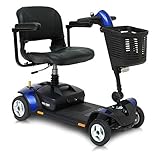
Pride Go-Go Elite Traveller LX. Class 2, 4mph, splits into five pieces with the heaviest at 15.2kg according to Pride. A sturdier four-wheel boot scooter. Read our review.
| Photo | Title | Price | Buy |
|---|---|---|---|
| Pride Mobility Go-Go Elite Traveller LX – 4 Wheel Mobility Electric for Adult (Blue) | £1,095.00 |
|
As an Amazon Associate I earn from qualifying purchases. (paid link)
Class 3 picks: road and pavement
Scooterpac Savvy 8. Scooterpac’s spec sheet (reference SP/SAV8/SS/V1-24) gives Class 3, 8mph, 125kg with batteries, 652mm wide, a 180kg weight capacity and up to 28 miles of range. Well inside both the weight and width limits.
Not currently available on Amazon (checked 13 October 2026). Scooterpac sells the Savvy 8 through its own dealer network, so ask a local dealer for a price.
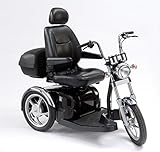
Drive Sport Rider. Drive’s manual calls it a class 3 invalid carriage with an 8mph top speed and a 4mph slow setting. It gives 135kg with batteries, 78cm wide and a 180kg user limit. Drive’s page quotes 28 miles on 70Ah batteries and 31 miles on 100Ah batteries.
| Photo | Title | Price | Buy |
|---|---|---|---|
| Drive Medical Sport Rider Stylish 3 Wheel Class 3 Mobility Scooter |
|
As an Amazon Associate I earn from qualifying purchases. (paid link)
For a third documented Class 3 option and more detail, see our Class 3 scooter guide.
Paid links: we earn a commission if you buy through the Amazon boxes. That does not change which scooters appear here. We list only scooters whose maker’s own documents give the class. Prices in the boxes are live from Amazon and change often. Spotted an error? Email hello@reviewmobility.co.uk.
Frequently asked questions
Do you need a licence for a mobility scooter in the UK?
No, not for a Class 2 or Class 3 scooter. GOV.UK says a vehicle that is not in a class, because it can go faster than 8mph, is wider than 0.85 metres or is heavier than the limits, needs a valid driving licence.
How old do you have to be to drive a mobility scooter?
Regulation 4 of the Use of Invalid Carriages on Highways Regulations 1988 says a Class 3 scooter must not be used by anyone aged under 14. No minimum age is set for a Class 2 pavement scooter.
Do mobility scooters need tax, an MOT or insurance?
There is no vehicle tax to pay and no MOT. A Class 3 scooter must be registered with DVLA, free of charge. Insurance is recommended but not legally required for Class 2 or 3.
Is it illegal to drive a mobility scooter drunk?
The Chronically Sick and Disabled Persons Act 1970 disapplies sections 1 to 4 of the Road Traffic Act 1988, including the unfit-through-drink-or-drugs offence, for a Class 2 or 3 scooter that meets the regulations. That does not make impaired riding safe, and it does not cover vehicles outside the classes.
Can you drive a mobility scooter on the road?
Only a Class 3 scooter, registered with DVLA and fitted with lights, indicators, a horn and a rear view mirror. Scooters must not use motorways, bus lanes or cycle lanes, and need a flashing amber light on a dual carriageway with a limit over 50mph.
Is a scooter sold as “road legal” always a Class 3?
Not necessarily. Ask the seller for the maker’s manual or spec sheet that states the class. When we checked eight road-type scooters on Amazon UK on 28 September 2026, three had one. See which class should you buy.
Are the mobility scooter rules changing?
Possibly. The Department for Transport consulted from 6 January to 22 April 2026 on modernising the law, including speed, weight and age limits. As of 27 September 2026 no response had been published, so the existing rules still apply.
Sources
GOV.UK, Using mobility scooters and powered wheelchairs (overview, classes, driving on the road, driving on footpaths and parking, eyesight requirements, vehicle tax, registration and insurance); the Highway Code, rules 36 to 46; DVLA leaflet INF304, Registering a mobility vehicle (March 2024) and form V55/MV; the Use of Invalid Carriages on Highways Regulations 1988 (SI 1988/2268), regulations 3, 4, 7, 9, 10, 11, 12 and 14; the Chronically Sick and Disabled Persons Act 1970, section 20; Department for Transport, Reviewing the law for powered mobility devices (consultation page and press release, 6 January 2026). All read 27 September 2026. Product checks: Scooterpac Savvy 8 specification sheet SP/SAV8/SS/V1-24; Drive DeVilbiss Sport Rider user manual (2026-03 Rev4 UKCA) and product page; Drive DeVilbiss Royale Scooter Range user manual (2022-10 Rev3); Veleco UK product pages for the ZT15, Gravis, Turris and Draco; iCAN X-02 product page; Amazon UK search results. All read 28 September 2026.
Published 23 June 2026 · Last updated 13 October 2026