
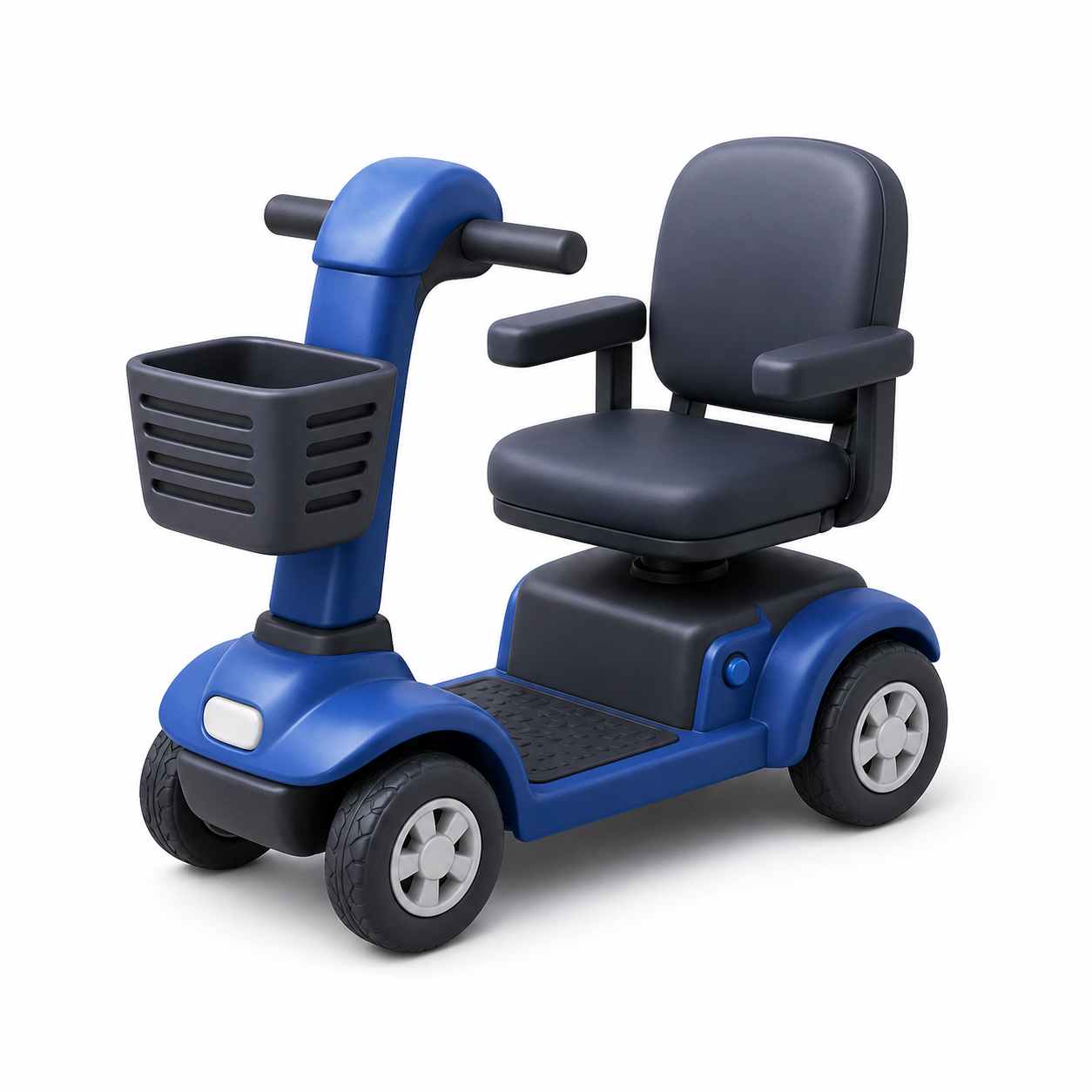
Mobility Scooters
Find the perfect mobility scooter with our expert guides, comparisons and buyer advice. From lightweight portables to all-weather models.
Mobility scooters in the UK: the short answer
- Two legal classes. Class 2 does 4 mph and is for pavements. Class 3 does 8 mph on the road and 4 mph on the pavement.
- No driving licence is needed for either, and no test.
- Only a Class 3 must be registered with the DVLA, on form V55/MV. It is free, there is no vehicle tax, no number plate and no MOT.
- You must be 14 or over to use a Class 3. There is no minimum age in law for a Class 2.
- Insurance is not a legal requirement for either class, but it is widely recommended and cheap.
- Prices run from about £450 to £4,500. Most people buying their first pavement scooter spend £700 to £1,500.
- You can only drive one if you have trouble walking through injury, disability or a medical condition, or you are testing, demonstrating, repairing or teaching on it.
Browse Mobility Scooters
Explore our guides, reviews and comparisons.
Best Scooter Batteries
Class 2 vs Class 3
Rules & the Law
Which Scooter Is Right for Me?
Best Mobility Scooters
Best Lightweight
Best Portable
Best All-Weather
Best Waterproof Covers
Battery Lifespan Estimator
Sell a Mobility Scooter
Mobility Scooter Blog Posts
Latest guides, reviews and advice.

Best Mobility Scooter Batteries UK: 9 Ranked Against the Makers’ Own Datasheets
read more
Winter-Proofing a Mobility Scooter: What Actually Helps When It Gets Cold
read more
How Much Do Mobility Scooter Batteries Cost to Replace?
read more
Buying a Used Mobility Scooter: Checklist, Prices and Pitfalls
read more
Mobility Scooter Insurance UK: What Six Providers Actually Offer
read more
Best Mobility Scooter Lights and High Visibility Kit UK
read moreMobility Scooters: Finding the Right Fit
Mobility scooters give you the freedom to get out and about independently, whether that means popping to the shops, visiting friends, or exploring the local park. With a wide range of models available in the UK, finding the right scooter depends on where you plan to use it, how far you need to travel, and how you will transport it.
Classes of Mobility Scooter
Class 2 scooters are designed for pavement use and have a maximum speed of 4 mph. They are compact and often foldable, making them ideal for indoor shopping centres and short trips. Class 3 scooters can be used on the road and reach up to 8 mph. They must be registered with the DVLA (free of charge) and fitted with lights, indicators, and mirrors.
What to Consider Before Buying
Think about the terrain you will cover most often. If you live in a hilly area, you will need a scooter with a powerful motor and good battery range. Storage is another important factor, as some models fold down to fit in a car boot while others need a dedicated space at home. Weight capacity, seat comfort, and suspension quality all affect day-to-day usability.
Costs and Funding
A basic folding scooter starts from around £500, while mid-range models cost £1,500 to £3,000. High-end Class 3 road scooters can reach £5,000 or more. The Motability scheme allows eligible users to lease a scooter using their mobility allowance. Second-hand scooters through reputable dealers can also offer good value.
Class 2 versus Class 3 mobility scooters compared
UK law calls both an invalid carriage and splits them by speed under the Use of Invalid Carriages on Highways Regulations 1988. Class 2 is a pavement scooter limited to 4 mph. Class 3 can reach 8 mph on the road but must drop to 4 mph on a pavement. Everything else, the paperwork, the weight limits, the equipment, follows from that one difference.
| Class 2 (pavement) | Class 3 (road legal) | |
|---|---|---|
| Top speed | 4 mph | 8 mph on the road, 4 mph on the pavement |
| Where you can use it | Pavements, pedestrian areas, footpaths, bridleways and cycle tracks. On the road only where there is no pavement | Pavements and the road. Not motorways. Not bus lanes or painted cycle lanes |
| Maximum unladen weight | 113.4 kg, or 200 kg with necessary user equipment | 150 kg, or 200 kg with necessary user equipment |
| Maximum width | No limit in law | 0.85 m |
| DVLA registration | Not required | Required, using form V55/MV |
| Vehicle tax | None | Nil rate, but it still has to be registered |
| Number plate | No | No |
| MOT | No | No |
| Driving licence | No | No |
| Minimum age | None set in law | 14 |
| Insurance | Not required by law, recommended | Not required by law, recommended |
| Equipment it must have | Brakes that hold on a 1 in 5 slope, lights if used on the road after dark, a clear view ahead | Lights, reflectors, indicators that also work as hazards, a horn, a rear-view mirror, a speed indicator and a 4 mph limiter that must be switched on before you use a pavement |
| Typical UK price | £450 to £1,600 | £1,300 to £4,500 |
There is a third category that catches people out. A powered vehicle that goes faster than 8 mph, is wider than 0.85 m, or weighs more than 150 kg (200 kg with equipment) is not in a class at all. It cannot be used on a pavement, it needs a driving licence, and if it weighs more than 254 kg you must insure it.
Do you have to register a Class 3 mobility scooter with the DVLA?
Yes. A Class 3 scooter must be registered with the DVLA before it is used on the road. A Class 2 pavement scooter does not need registering at all.
Use form V55/MV. This is the point most guides get wrong. V55/MV is the application for first vehicle tax and registration of a mobility vehicle or powered wheelchair at 5 to 8 mph, and it is the correct form whether the scooter is new or second hand. The older advice to use V55/4 for a new machine and V55/5 for a used one now applies only to vehicles that are not in a class, meaning faster, wider or heavier than the Class 3 limits.
What you send with it: the completed form, evidence that the vehicle is new (a certificate or written declaration from the manufacturer) or evidence of the date of manufacture if it is used, and evidence of its speed and unladen weight, which can be a letter or printed email from the manufacturer or supplier. Post it to DVLA, Swansea, SA99 1BE.
What you do not need: a fee, vehicle tax, number plates, an MOT or a driving licence. You should receive a V5C registration certificate within four weeks for a new vehicle or six weeks for a used one.
Are two-seater or tandem mobility scooters legal in the UK?
No, not on pavements or roads. UK law defines an invalid carriage as a vehicle “constructed or adapted for use for the carriage of one person”, so a machine built with a second seat falls outside the definition and loses the rights that go with it. The Department for Transport puts it plainly: two person mobility vehicles are not permitted to be used on the public highway.
The same rule is why you cannot carry a passenger on an ordinary scooter, including a grandchild on your lap or standing in the footwell. Two-seat models are sold in the UK, and owning one is perfectly lawful, but they are private land only. If you need to travel with someone, the road-legal alternatives are a licensed quadricycle or microcar, which need registration, a licence, insurance and tax, and cannot use pavements.
Tandem in the other sense, towing, is also out. The Road Vehicles (Construction and Use) Regulations 1986 permit an invalid carriage to draw no trailers at all. A basket, rear platform or dog carrier built into the scooter itself is part of the vehicle and is fine.
This one may change. The Department for Transport consultation “Reviewing the law for powered mobility devices” ran from 6 January to 22 April 2026 and asked directly whether passengers should be allowed and on what conditions. The government response had not been published when this page was last updated, so the position above is still the law.
Compare mobility scooters by what you actually need
Specifications only matter once you know which job the scooter has to do. Start from the situation, not the spec sheet.
| Your situation | Where to compare | Typical spend |
|---|---|---|
| You want the best all-round buy | Best mobility scooters | £450 to £4,500 |
| You need to lift it into a car boot | Best lightweight scooters | £500 to £2,500 |
| You travel, fly or go on cruises | Best folding scooters for travel | £500 to £2,500 |
| You want to use the road at 8 mph | Best Class 3 road-legal scooters | £1,300 to £4,500 |
| You are on a tight budget | Best scooters under £800 | under £800 |
| Your area is hilly | Best scooters for steep hills | £1,000 to £3,500 |
| You are tall or a heavier rider | Best scooters for a tall person | £900 to £3,000 |
| You go across grass, gravel or fields | Best all-terrain scooters | £1,200 to £4,000 |
| You ride in all weathers | Best all-weather scooters | £1,500 to £4,500 |
| You are not sure where to start | Free Scooter Finder tool | free |
Two things worth knowing before you compare on price. Quoted ranges are laboratory figures, so take 20 to 30 percent off for British hills, cold weather and a heavier rider. And most dealers can supply a scooter at 0% VAT if you have a long-term illness or disability, which is worth around £300 on a £1,500 machine, while online marketplaces normally cannot.
Mobility scooter terms explained
- Invalid carriage
- The legal term for a mobility scooter or powered wheelchair in UK law. It matters because the rights to use a pavement, and the exemptions from licensing and tax, attach to this definition rather than to the product name.
- Class 2
- A mobility scooter limited to 4 mph, for pavement use. No DVLA registration, no licence, no minimum age in law.
- Class 3
- A mobility scooter capable of 8 mph on the road, with a 4 mph limiter for pavements. Must be registered with the DVLA and used only by someone aged 14 or over.
- Not in a class
- A powered vehicle that exceeds the Class 3 limits on speed, width or weight. Road only, driving licence required, and insurance is compulsory above 254 kg.
- Unladen weight
- The weight of the scooter including batteries, fuel and any equipment you need, but not the rider. This is the figure the legal weight limits use, and it is not the same as a manufacturer’s “kerb weight”.
- Boot scooter
- A scooter that comes apart into sections so it fits in a car boot. The number that matters is the weight of the heaviest single piece, not the total.
- Freewheel
- A lever that disengages the motor so the scooter can be pushed by hand. Useful when a battery dies, and the reason a scooter should never be left in freewheel on a slope.
- VAT relief
- Zero-rated VAT on mobility equipment for people with a long-term illness or disability. You sign a short declaration at the point of sale.
Official sources
- GOV.UK: mobility scooters and powered wheelchairs rules
- The Highway Code, rules 36 to 46
- The Use of Invalid Carriages on Highways Regulations 1988
- Chronically Sick and Disabled Persons Act 1970, section 20
- DfT consultation: reviewing the law for powered mobility devices
Frequently Asked Questions
Do I need a licence to use a mobility scooter?
Can I take a mobility scooter on public transport?
How far can a mobility scooter travel on one charge?
Do I need insurance for a mobility scooter?
What is the difference between a Class 2 and a Class 3 mobility scooter?
Do you have to register a mobility scooter with the DVLA?
Can a mobility scooter go on the road?
Are two seater mobility scooters legal in the UK?
How much does a mobility scooter cost in the UK?
Mobility Scooter Companies A to Z
Listed A to Z, not ranked. We only rank companies when enough of them have at least 3 reviews, with at least one from the last 18 months, and this category is not there yet. No company can pay for a place on this list, to improve a score, or to remove a review. How we check reviews.

A Mobility Shop
A Mobility Shop is a family-run mobility and independent-living retailer based on Thomas Lane in Liverpool, established in 1989. With more than 35 years…
View Profile & Reviews
A6 Mobility Shop
Stockport mobility retailer at The Courtyard on Wellington Road North selling mobility scooters, stairlifts, wheelchairs, riser recliners and living aids, including the eFOLDi folding…
View Profile & Reviews
Ability Superstore
Online mobility and daily living aids retailer operated by Specialist Mobility Ltd from Nelson, Lancashire. Stocks over 7,000 products including scooters and scooter accessories,…
View Profile & Reviews
Able Access UK
Able Access UK is a Birmingham-based disability equipment and home adaptation specialist serving customers across the West Midlands. The company provides comprehensive home adaptation…
View Profile & Reviews
Ableworld Mobility & Stairlifts Lincoln
Ableworld Mobility and Stairlifts Lincoln is part of Ableworld, the largest mobility and stairlift retailer in the United Kingdom with 41 stores nationwide. The…
View Profile & Reviews
Ableworld Mobility & Stairlifts Southport
Here at Ableworld Southport we are located in a large premises providing free parking and including disabled parking bays and an accessible store entrance.…
View Profile & Reviews
Access Able
Have you used Access Able? Reviews on this page come from Review Mobility readers, not from the company. Testimonials on a supplier website are…
View Profile & Reviews
Access Care Mobility
Access Care Mobility is a mobility equipment retailer based in Nottinghamshire, providing a range of products and advisory services to help customers find suitable…
View Profile & Reviews
Action 2 Mobility
Action 2 Mobility is a long-established, family-run mobility retailer based in Rushden, Northamptonshire, trading since 1980. It is a full-range supplier with its own…
View Profile & Reviews
Active Days Mobility
Active Days Mobility is a mobility equipment retailer with over 16 years of experience, operating from multiple locations across East Sussex. Their main store…
View Profile & ReviewsTypes of Mobility Scooter Explained
Understanding the different types of mobility scooter is essential before making a purchase.
Class 2 Pavement Scooters
Class 2 scooters are limited to 4 mph and designed for pavement use only. They are the most popular type in the UK. No DVLA registration is required. Prices range from £600 to £2,500, with most buyers spending around £1,200. Class 2 scooters suit people who mainly use their scooter for local trips.
Class 3 Road-Legal Scooters
Class 3 scooters can travel up to 8 mph on the road and must be registered with the DVLA (free of charge). They require lights, indicators, mirrors and a horn. Prices range from £1,500 to £7,900, averaging around £3,600. They are designed for longer journeys and rural areas.
| Feature | Class 2 | Class 3 |
|---|---|---|
| Maximum speed | 4 mph | 8 mph (4 on pavement) |
| Road use | No | Yes |
| DVLA registration | Not required | Required (free) |
| Range | 5-15 miles | 15-45 miles |
| Price | £600-£2,500 | £1,500-£7,900 |
Folding and Travel Scooters
Folding scooters collapse to fit in a car boot. The lightest weigh under 20 kg. Prices range from £530 to £2,500.
Costs and Funding Options
A basic folding scooter starts from around £530, while mid-range Class 2 models cost £1,000 to £2,000. The average UK mobility scooter costs around £2,600. The Motability Scheme allows eligible users to lease a scooter using their enhanced rate mobility allowance from PIP. Buy at 0% VAT if chronically sick or disabled. For full pricing, see our Mobility Scooter Costs guide.
Top UK Mobility Scooter Brands
TGA Mobility manufactures in Suffolk with high build quality. Kymco Healthcare operates a UK factory in Wigan. Pride Mobility has the widest product range. Drive DeVilbiss offers the most affordable options. Invacare is a global brand with durable construction.
Insurance and Legal Requirements
Insurance is not legally required but is recommended. Basic cover starts from £40 per year. Comprehensive cover costs £100 to £300 per year. Class 3 scooters must be registered with the DVLA (free). No driving licence, MOT or road tax is needed.
Charging, Batteries and Range
Charging costs 5p to 15p per charge, roughly £15 to £40 per year. Range varies from 5 miles (folding) to 45 miles (premium Class 3). Batteries last 18 months to 3 years. Replacement costs £50 to £450.