
Published 6 July 2026 · Last updated 25 September 2026
We only recommend products we think are worth it. Some links on this page are affiliate links: if you buy through one we earn a commission from Amazon, at no extra cost to you, and as an Amazon Associate we earn from qualifying purchases. It never changes which products we pick or how we rank them. This is not medical advice. If you are unsure what you need, ask your GP or occupational therapist.
A self-propelled wheelchair has large rear wheels with hand rims, so the user can wheel themselves rather than relying on someone to push. That independence is the whole point. They are a bit heavier and bulkier than transit chairs, so here is how to choose, and four we rate.
How to choose a self-propelled wheelchair
Make sure self-propelled is right. The user needs the arm strength and hand function to turn the wheels. If someone will always push, a lighter transit wheelchair is easier to handle.
Weight and quick-release wheels. The big rear wheels add weight and bulk. Chairs with quick-release wheels come apart to fit a car boot far more easily, which is worth looking for.
Seat width. Measure across the hips seated and add a little room. A good fit makes self-propelling far less tiring.
Weight limit and tyres. Check the user weight limit, and note that solid puncture-proof tyres save maintenance, while pneumatic tyres give a softer ride outdoors.
The best self-propelled wheelchairs




As an Amazon Associate I earn from qualifying purchases. (paid link)
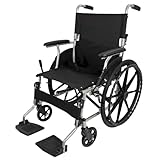
Best overall: Days Whirl Self-Propelled Wheelchair
A simple, dependable self-propelled chair from Days, one of the most trusted UK mobility brands. Comfortable, well built and easy to live with day to day.
The catch: as with any self-propelled chair, the large wheels make it heavier to lift than a transit chair. Around £220.
| Photo | Title | Price | Buy |
|---|---|---|---|
|
| Days Whirl Self Propelled Steel Wheelchair Foldable 41cm Seat Silver | 120kg Maximum User Weight, Removable Armrests, Quick-Release Rear Wheels, Half-Folding Backrest, Compact Storage | £219.99 |
|
As an Amazon Associate I earn from qualifying purchases. (paid link)
Best lightweight: MobiQuip 12kg Self-Propelled Wheelchair
At around 12 kg this is notably light for a self-propelled chair, which makes pushing and lifting easier. A strong pick if weight is your main concern.
The catch: the light weight comes at a higher price than budget chairs. Around £329.
| Photo | Title | Price | Buy |
|---|---|---|---|
|
| MobiQuip Lightweight Wheelchair - Self-Propelled - 13.75kg, 20" Seat | £329.00 |
|
As an Amazon Associate I earn from qualifying purchases. (paid link)
Best budget: Actiasgear Aluminium Self-Propelled Wheelchair
Well rated and easily the cheapest way into a self-propelled chair, in lightweight aluminium. A sensible starting point or back-up chair.
The catch: a newer brand, so support and spares are less established than Days. Around £80.
| Photo | Title | Price | Buy |
|---|---|---|---|
|
| Actiasgear - Aluminium Self-Propelled Wheelchair - Lightweight, Folding, with Mag Wheels, Brakes & Armrests, Black (YES - I am VAT Exempt) | £77.99 |
|
As an Amazon Associate I earn from qualifying purchases. (paid link)
Best value with high capacity: VOCIC Folding Self-Propelled Wheelchair
A folding chair with double brakes and a 150 kg weight limit, so it suits heavier users without a big price tag.
The catch: a mid-market brand rather than a long-established name, so lean on recent reviews. Around £200.
| Photo | Title | Price | Buy |
|---|---|---|---|
|
| VOCIC Lightweight Folding Wheelchair, Self Propelled, Max 150KG, 60cm Tires | Self Propelled Transport Wheelchairs for Disabled & Adults, All Terrain Large Tyres, Stable and Robust, Double Brakes, Gray | £239.99 |
|
As an Amazon Associate I earn from qualifying purchases. (paid link)
Prices are a guide and change often, so check the live price on Amazon before you buy.
Watch: using a self-propelled wheelchair
This official guide from the British Red Cross shows how to use a self-propelled wheelchair.
Frequently asked questions
Do I need arm strength to use a self-propelled wheelchair?
Yes. Self-propelling means turning the hand rims on the large rear wheels, so you need reasonable arm and hand function. If that is difficult, a transit chair pushed by someone else, or a powered chair, may suit better.
Are self-propelled wheelchairs heavier than transit ones?
Usually yes, because of the large rear wheels. Look for a lightweight aluminium frame and quick-release wheels to make lifting into a car easier.
Will it fit in my car?
Most fold, and models with quick-release rear wheels pack down much smaller. Check the folded dimensions against your boot before buying.
Can I get one on the NHS?
Sometimes, through your local NHS wheelchair service after a referral, though waits and eligibility vary. Many people buy their own for flexibility.
What is the difference between a self-propelled and a transit wheelchair?
Self-propelled chairs have large rear wheels with hand rims, so the user can push themselves. Transit chairs have small wheels and must be pushed by somebody else. If the person can propel at all, self-propelled preserves independence that is hard to get back once it is lost.
What size rear wheels should it have?
Around 24 inches is standard for self-propelling. Smaller rear wheels reduce the chair’s weight but make pushing harder and kerbs close to impossible, which defeats the point of the chair.
How do I get the seat size right?
Measure across the widest part of the hips while seated and add about an inch overall. Too narrow causes pressure at the hips; too wide lets the person slump sideways, which causes posture problems over a full day.
Do I need a cushion as well?
Almost certainly. The sling seat that comes with most chairs is not pressure care, and anyone sitting for more than a couple of hours at a time should have a cushion matched to their risk level, ideally specified after an assessment.
Can I push myself with only one working arm?
A standard chair is difficult one-handed. The options are a one-arm-drive chair, a hemi-height chair set low enough to propel with a foot, or a powered chair. This is a case for an assessment rather than a catalogue.
Do I pay VAT on a self-propelled wheelchair?
Wheelchairs are zero-rated for eligible disabled buyers when the declaration is made at the point of purchase, and that often extends to cushions and accessories bought at the same time. VAT cannot be reclaimed afterwards, so make the declaration when you order.
If someone will always push, compare our transit wheelchairs guide, and add a wheelchair cushion for comfort. See all our wheelchair guides.
Published 6 July 2026 · Last updated 25 September 2026