
Published 27 July 2025 · Last updated 22 October 2026
Links to Amazon on this page are paid links: we earn a commission if you buy, at no extra cost to you. No company paid to appear here. How we make money.
Quick answer: A folding electric wheelchair suits someone who can sit in a wheelchair for most of the day but cannot push themselves far, and who needs the chair to fit in a car boot or go on holiday. Judge each model on three numbers before anything else: the weight of the heaviest piece you or a helper will lift, the folded size against your boot, and the battery rating in watt-hours if you plan to fly. Nearly all folding powerchairs are Class 2, so they need no registration and are limited to 4 mph. If you are eligible, buy without VAT, and ask for an NHS wheelchair assessment before you spend your own money.
Folding electric wheelchairs compared
These chairs are sold through Amazon UK, and prices and stock come live from the retailer. The weights and ranges in the listing titles are the sellers’ own figures. Check whether a quoted weight includes the battery and footrests, because that changes the number you actually lift.
In stock on Amazon UK when we checked on 13 October 2026. Prices shown are live from Amazon.
| Photo | Title | Price | Buy |
|---|---|---|---|

| DAHAIY Compact & Folding Lightweight Electric Wheelchair for Adults, Travel | Fold up Power Wheelchair with 15.5 Miles Long Range 500W Motor,Foldable Motorized Mobility for Indoor & Outdoor Use | £399.00 |

|
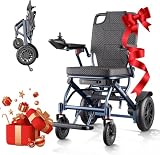
| D14 Folding Electric Wheelchair for Adults with Removable Lithium Battery | Up to 20km Range,500W Motor, Lightweight & Compact Aluminium Powerchair, Ultra-Portable,Travel-Friendly & Airline-Friendly | £409.99 |
|
As an Amazon Associate I earn from qualifying purchases. (paid link)
How to choose a folding electric wheelchair
The weight you will actually lift
The lightest folding powerchairs are listed at around 17 to 20 kg with the battery removed, and many sit between 20 and 30 kg. Ask who will lift it into the car. If it is an older partner, even 20 kg in one piece may be too much, and a car hoist or a boot ramp becomes part of the cost.
Folded size and your car boot
Measure the height of the boot opening as well as the floor depth, because the tallest point of a folded chair is usually the wheels and the backrest. Take the measurements with you, or ask the seller for folded dimensions in centimetres before you order.
Range and battery
Folding models use lithium batteries, and a removable battery lets you charge it indoors. The range on the listing is measured in good conditions. Hills, cold weather, soft ground and a heavier user all cut it, so plan on getting noticeably less than the headline figure. A second battery doubles the range but adds cost.
Flying with a folding powerchair
Airlines follow IATA rules for mobility aids with lithium batteries. IATA guidance allows a removed lithium-ion battery of up to 300 Wh, and spare batteries up to a combined 300 Wh per mobility aid, carried in the cabin and protected from damage. You will need to know the battery rating in watt-hours, so check it is marked on the battery. Tell the airline well before you travel, as most ask for notice and some want it at least 48 hours ahead.
Seat size and weight limit
Folding chairs are narrower than full-size powerchairs, with seats often around 40 to 46 cm wide, and user limits commonly between 100 and 150 kg. Sit in a similar chair if you can. A seat that is too narrow rubs at the hips, and one that is too shallow gives no support under the thighs.
Controls, kerbs and terrain
Check the joystick can be fitted on the side of your stronger hand, and whether an attendant control is available if someone will sometimes drive it from behind. Small wheels make these chairs easy to fold but limit them on kerbs, grass and gravel. Look for the stated maximum slope and kerb height, and use dropped kerbs where you can.
Class 2 wheelchairs and the law
Most folding electric wheelchairs are Class 2 invalid carriages. They are for pavement use, are limited to 4 mph and do not need to be registered with the DVLA. Class 3 vehicles can travel at up to 8 mph on the road and must be registered with the DVLA. Insurance is not a legal requirement for either class, but it is worth having for theft, damage and third-party claims.
Ways to pay less
- Buy it without VAT if you have a disability or long-term illness and the chair is for your personal use. You sign a declaration before paying. See our VAT relief guide.
- Ask your GP to refer you to the NHS wheelchair service. If you need a powered chair indoors and outdoors, you may be assessed for one, or offered a personal wheelchair budget towards a chair you choose. Waiting times vary widely, as our NHS wheelchair waiting times research shows.
- If you receive the higher rate mobility component of DLA or the enhanced mobility rate of PIP, you can lease a powered wheelchair through the Motability Scheme.
- Compare what powered chairs cost from specialist dealers in our powerchair costs guide.
Before you buy online
- Find out who pays return carriage on a heavy item, and how long you have to return it.
- Ask who services the chair in the UK and whether spare parts, batteries and tyres are available.
- Check the warranty on the battery separately from the frame. Batteries often have a shorter cover.
- Wheelchairs are medical devices. Look for UKCA or CE marking and a named UK importer or responsible person on the listing or the box.
Frequently asked questions
What is a folding electric wheelchair?
It is a battery-powered wheelchair with a frame that folds, usually in a few seconds, so it can be lifted into a car boot or stored at home. Most are Class 2 chairs for pavement and indoor use, with a top speed of 4 mph.
How heavy is a folding electric wheelchair?
The lightest models are listed at around 17 to 20 kg without the battery, and most weigh between 20 and 30 kg. Check whether the weight quoted includes the battery and footrests.
Can I take a folding electric wheelchair on a plane?
Usually, yes. IATA guidance allows a removed lithium-ion battery of up to 300 Wh, plus spares up to a combined 300 Wh per mobility aid, carried in the cabin. Contact the airline before you book and again before you fly, as most need advance notice.
Do I need to register or insure a folding powerchair?
A Class 2 chair does not need to be registered with the DVLA, and insurance is not a legal requirement. Insurance is still sensible to cover theft, accidental damage and injury to other people.
Can I get a powered wheelchair on the NHS?
You may, if an NHS wheelchair service assessment finds you need one. Criteria vary by area but usually include being unable to self-propel and needing the chair indoors. Some services offer a personal wheelchair budget instead.
Is a folding powerchair or a mobility scooter better?
A powerchair turns in a smaller space and works indoors, so it suits someone who needs a chair all day. A scooter is usually for outdoor trips by someone who can walk short distances. Our wheelchair vs scooter guide compares the two.
Related guides
- Best powerchairs
- Best travel wheelchairs
- Best wheelchairs
- Best wheelchair ramps
- How much does a wheelchair cost?
Published 27 July 2025 · Last updated 22 October 2026