
Published 25 September 2026
We only recommend products we think are worth it. Some links on this page are affiliate links: if you buy through one we earn a commission from Amazon, at no extra cost to you, and as an Amazon Associate we earn from qualifying purchases. It never changes which products we pick or how we rank them. This is not medical advice. Parkinson’s affects everyone differently; an occupational therapist or speech and language therapist can assess what will actually help.
Short answer. Mealtimes with a tremor or stiffness usually need three cheap fixes: something to push food against (a plate guard or a high-sided plate), something that stops the plate moving (a non-slip mat), and a cup that forgives a shake (two handles, a lid, or both). Everything here is under £20. Before buying, ask your GP or Parkinson’s nurse for an occupational therapy referral, because much of this equipment is supplied free after an assessment, and get a swallowing assessment before changing cups if swallowing is affected.
Get the free help first
An occupational therapist can supply eating aids on loan and, more usefully, watch a mealtime and spot what a catalogue cannot. A speech and language therapist assesses swallowing, which matters because the wrong cup can make swallowing problems worse, not better. Both come free through a GP or Parkinson’s nurse referral. Parkinson’s UK runs a free confidential helpline on 0808 800 0303 and can point you to local support. None of the products below replaces any of that; they are the small tools for the everyday meals in between.
The picks compared



As an Amazon Associate I earn from qualifying purchases. (paid link)
Plate guards and shaped plates
The clip-on guard: cheapest fix for an existing plate
A plate guard clips to the rim of a normal dinner plate and gives food a wall to be pushed against, so one hand can load a fork without chasing peas around the china. It is the discreet option: it comes off when guests arrive, and the plate underneath stays the plate you already own. Skip it if the plates are very thick or deeply rimmed, because clip-on guards want a fairly standard edge.
| Photo | Title | Price | Buy |
|---|---|---|---|
|
| Homecraft Surrounded Incurved Dish and Plate Guard, Non Slip Eating Aid for Elderly, Disabled and Handicapped Users | £5.99 |
|
As an Amazon Associate I earn from qualifying purchases. (paid link)
The shaped plate: better for one-handed eating
A contoured or scoop plate builds the wall in, with a low front edge and a high back wall that curves food onto the fork. The Homecraft Manoy is the long-standing NHS-catalogue shape; the cheaper suction-base scoop plates add grip on the table but look more clinical. Skip shaped plates if appearance at the table matters more than function to the person using it. That is a real preference, not vanity, and the clip-on guard respects it.
| Photo | Title | Price | Buy |
|---|---|---|---|
|
| HOMECRAFT Manoy Contoured Plates, Small, High Walled Plate, Scoop Dish with Raised Walls for Users to Scoop Foods onto Utensils, Melamine Plate for Users with Limited Motor Function | £14.99 |
|
As an Amazon Associate I earn from qualifying purchases. (paid link)
Cups that forgive a tremor
Two handles beat one, a lid beats no lid, and weight is a matter of taste: some people find a heavier cup steadier, others tire faster. Start with a two-handled cup with a removable lid, so it can become an ordinary cup on good days.
| Photo | Title | Price | Buy |
|---|---|---|---|
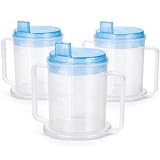
| LIFE Healthcare Spill-Proof Two-Handled Drinking Cups for Adults, Pack of 3 | £19.99 |
|
As an Amazon Associate I earn from qualifying purchases. (paid link)
One caution that outranks everything else here: if there is any coughing or choking with drinks, do not buy a spouted cup on a guess. Spouts and one-way straws change how liquid arrives at the throat, and what helps one swallowing pattern is wrong for another. Ask for a speech and language therapy assessment first.
Stop the plate moving
A non-slip mat under the plate removes the second moving part from the equation. Silicone table mats wipe clean and double as heat protection; the cut-to-size fabric rolls do the same job for less and can also line trays and armrests. Aidapt’s silicone mats in the comparison above are the tidy version; a roll of non-slip fabric is the cheap one.
What about cutlery?
Weighted and easy-grip cutlery has its own guide, including our take on the mixed evidence for weighted handles and a tremor: see our adaptive cutlery comparison. For jars, taps and kitchen prep with stiff or weak hands, our jar openers and grip aids guide and kitchen aids guide cover the rest of the kitchen, and a kettle tipper takes the riskiest pour out of the day.
How to choose
- Fix the plate first, then the cup. Most mealtime frustration is food escaping the fork.
- Buy one of each type, not three of one. What helps depends on the person, and these are £5 to £20 experiments.
- Prefer things that pass as normal tableware where you can. Equipment that embarrasses does not get used.
- Swallowing changes are a referral, not a shopping trip.
Frequently asked questions
What eating aids help with Parkinson’s?
The usual set is a plate guard or high-sided plate, a non-slip mat, a two-handled cup with a lid, and adapted cutlery. Most people need two or three of those, not all of them.
Can you get eating aids free on the NHS?
Often, yes. An occupational therapist can supply plates, cups and cutlery after an assessment, referred through your GP or Parkinson’s nurse. Buying from Amazon is the fast route, not the only one.
What cup is best for someone with a tremor?
Two handles and a lid, as a starting point. Weight divides opinion, so try before committing to a heavy cup. If there is any coughing with drinks, get a swallowing assessment before buying anything.
Do plate guards work?
For one-handed eating and for pushing food onto a fork, yes, and they are the cheapest item on this page. They need a fairly standard plate rim to clip onto.
Where can I get advice about living with Parkinson’s?
Parkinson’s UK runs a free confidential helpline on 0808 800 0303, with local advisers and specialist nurses behind it. Your GP can refer to occupational therapy and speech and language therapy.
Something on this page looks wrong to you?
Tell us and we will correct it. Email hello@reviewmobility.co.uk.
Published 25 September 2026