
Published 21 October 2024 · Last updated 22 October 2026
Links to Amazon on this page are paid links: we earn a commission if you buy, at no extra cost to you. No company paid to appear here. How we make money.
Quick answer: The right chair for an older person is mostly about seat height. Sitting back, their feet should rest flat on the floor with the knees level with or slightly below the hips. A seat that is too low is the most common reason people struggle to stand. A firm high-seat chair with solid armrests suits most people who can still stand with a push from the arms. If they need help to stand, a riser recliner does the lifting. Ask the council for a free occupational therapy assessment first: an OT will measure for you and may supply chair raisers, which can make an existing chair usable.
Want a ranking? See the 10 best riser recliner chairs, checked against their makers’ own documents: weight limits, space behind, power-cut back-up and warranty, compared.
Chairs for the elderly compared
These chairs are sold through Amazon UK, with live prices and stock from the retailer. The list mixes high-seat orthopaedic chairs, an adjustable-height chair and a riser recliner, because the right type depends on how the person stands up.
| Photo | Title | Price | Buy |
|---|---|---|---|
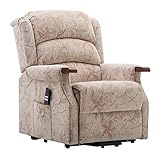
| Morris Living The Leicester Dual Motor Riser Recliner Mobility Lift Chair in Bouquet Beige | £499.99 |

|

| EURODIVANI Orthopaedic High Seat Chair (21" seat height) For the Elderly or Infirm Firm and comfortable, ideal for the disabled, immobile or people recovering from an operation or accident available… | £249.99 |
|

| Aidapt Longfield Height Adjustable Chair Ergonomically Designed to Give Lumbar Support, Wipe Clean Finish, Flat Packed, Easy Assembled, Brown | £139.99 |
|

| Aidapt Chesterfield Orthopaedic High Back Seat Chair With Adjustment for Leg and Back Height, Easy Wipe Clean Material For Use Elderly and Users With Limited Mobility In Living Rooms and Bedrooms. | £160.00 |
|
As an Amazon Associate I earn from qualifying purchases. (paid link)
Which type of chair?
High-seat (orthopaedic) chair
A firm, upright chair with a raised seat, usually sold in fixed heights such as 19 or 21 inches. It suits someone who can stand unaided with a push from the armrests. It is the simplest option and needs no power supply.
Adjustable-height chair
The legs adjust in steps, so the seat can be set to the person rather than the other way round. Useful when you are unsure of the right height or the chair may be used by more than one person.
Riser recliner
A powered chair that reclines for comfort and tilts forward to bring the person to their feet. It suits someone who cannot stand from a normal chair without help. Dual motor models move the back and footrest separately, which our single vs dual motor guide explains.
How to measure for a chair
- Seat height: measure from the floor to the back of the knee while seated, with shoes on. Choose a seat within an inch or so of that figure.
- Seat depth: measure from the back of the bottom to the back of the knee and take off two to three finger widths, so the seat edge does not press behind the knee.
- Seat width: measure across the hips and allow a little room either side for clothing and movement.
- Arm height: the armrests should let the elbows rest without the shoulders hunching, and reach far enough forward to push up from.
What else to check
- A firm cushion. Soft seats feel comfortable at first but make standing up much harder.
- A high back and side wings if the person dozes in the chair and needs head support.
- Wipe-clean or removable covers if continence is a concern.
- The fire safety label. New upholstered furniture sold in the UK should carry a permanent label showing it meets the fire safety regulations.
- For riser recliners, a battery backup so the chair can return to sitting in a power cut, and a handset with large buttons.
Ways to pay less
- Riser recliners designed for disabled people can be bought without VAT by someone with a disability or long-term illness. The declaration must be signed before you pay. See our VAT relief guide.
- An occupational therapy assessment from your local council is free. Chair raisers and other small aids are often supplied on loan.
- A lift cushion or stand assist aid can help with an existing chair for much less than a new one.
Watch: getting in and out of a chair safely
In this guide, UK specialist physiotherapist Will Harlow shows techniques for getting into and out of a chair more easily.
Frequently asked questions
What is the best seat height for an elderly person?
It depends on the person’s leg length. Measure from the floor to the back of the knee while seated with shoes on, and choose a seat close to that height. Most high-seat chairs are sold in heights between about 17 and 23 inches.
Is a riser recliner better than a high-seat chair?
Only if the person needs help to stand. A riser recliner lifts them to their feet, which a high-seat chair cannot do. For someone who can stand with a push from the arms, a firm high-seat chair is simpler, cheaper and has nothing to go wrong.
Why do older people find low chairs hard to get out of?
Standing from a low seat needs more strength in the thighs and more bend in the knees and hips. Raising the seat by even a few centimetres can make a large difference.
Can I get a chair for the elderly on the NHS?
Chairs are not usually supplied on the NHS, but your local council can arrange an occupational therapy assessment. Specialist seating may be provided where there is a clear need, and chair raisers are commonly supplied on loan.
Do riser recliners qualify for VAT relief?
Riser recliners designed for disabled people usually do, when bought for someone with a disability or long-term illness. The seller will ask for a signed declaration before the sale.
How do I stop an elderly person sliding forward in a chair?
Sliding forward is often a sign the seat is too deep or too soft, or the back reclines too far. A chair with a shorter seat depth and firmer cushion usually helps. An occupational therapist can advise if it keeps happening.
Related guides
- Riser recliner chairs UK guide
- Best recliner chairs
- Best recliner chairs for back pain
- Best electric adjustable beds
Published 21 October 2024 · Last updated 22 October 2026